
This question has been asked by email marketers for as long as dedicated sending infrastructure has existed. The fundamentals have not changed, but the details have. Here is an updated answer that reflects how warmup actually works in 2026.
Q: What’s the best way to build reputation on new IPs?
A: Building reputation on a new IP, or repairing a damaged one, is about earning trust from mailbox providers gradually and deliberately. You do that by sending the right mail, to the right people, at the right pace, with the right authentication in place.
There are several approaches to IP warmup, and methods can vary depending on your ESP, your sending infrastructure, and your audience. What follows is the methodology I have used and tested consistently over many years. It is one opinion, grounded in real-world experience. Adapt it to your specific circumstances.
Before You Send a Single Message: Authentication Is Non-Negotiable
Before any warmup begins, your authentication stack needs to be in place and verified. In 2026, SPF, DKIM, and DMARC are table stakes. No exceptions.
SPF tells receiving mail servers which IPs are authorised to send on behalf of your domain. DKIM adds a cryptographic signature to your messages that receiving servers use to verify the mail has not been tampered with in transit. DMARC ties SPF and DKIM together and tells mailbox providers what to do when a message fails authentication. Start at a monitoring policy (p=none) to collect data, then move to enforcement (p=quarantine or p=reject) as you confirm your sending streams are aligned.
Sending without DMARC in place during a warmup is like opening a new restaurant without a health inspection certificate. You might get away with it for a while, but it signals to the right people that something is off.
IP Versus Domain Reputation: Both Matter
A common misconception is that warmup is purely about the IP address. Mailbox providers, particularly Gmail and Microsoft, now weight domain reputation heavily alongside IP reputation. The good news is that the warmup process addresses both simultaneously, because you are sending from the same domain throughout.
Whether you are on a shared IP pool or a dedicated IP, the warmup rules are essentially the same. The main difference is the number of IPs involved, not the approach. Domain reputation has narrowed the gap between shared and dedicated infrastructure considerably.
The Warmup Ramp: Volume and Pace
Start at 500 emails per day per IP. Grow volume by 30% each day, monitoring engagement metrics closely as you go.
If your engagement is strong, meaning 40% or better open rates and 10% or better click rates, you can accelerate your daily growth to 50% per day. If engagement is weak or declining, slow your growth accordingly. Let the data drive the pace, not the calendar.
Mailbox providers are measuring how recipients respond to your mail in real time. Positive engagement signals tell them your mail is wanted. Negative signals tell them it is not.
The signals mailbox providers watch most closely during a warmup include:
- Unknown user rates (bounces to non-existent addresses)
- Spam and junk complaints from recipients
- Spam trap hits, including recycled traps and long-inactive addresses
- Concurrent connection attempts from your mail server
- Engagement rates: opens, clicks, and deletions without reading
Start With Your Best Audience
This is where most senders make a critical mistake. Warmup is not a volume exercise. It is a reputation-building exercise, and reputation is built on positive engagement.
Send exclusively to your most active and engaged subscribers during warmup. Use the last 120 days of engagement activity as your baseline audience. These are the people most likely to open, click, and not complain. Their positive response signals tell mailbox providers that your mail is legitimate and wanted, which is exactly the foundation you are building.
Do not warm up on cold lists, re-engagement campaigns, or contacts you have not mailed in months. Save those for when your reputation is established.
When Things Go Wrong
Warmup rarely goes perfectly. Deferrals, blocks, and complaint spikes are common, especially in the first two to three weeks. Here is how to respond.
Pull back volume. Do not push through resistance. Reduce your daily send to the last volume level that performed cleanly and hold there until metrics stabilise.
Pause for 48 hours if needed. If you are seeing significant blocks or complaint spikes, a short pause gives mailbox providers time to recalibrate and gives you time to investigate without compounding the problem.
Review your segments. Confirm you are actually sending to your active audience and that no segment errors have crept in. This happens more often than people admit.
Check your list hygiene. If your audience is genuinely your most engaged contacts from the last 120 days, hygiene should not be a problem. But verify anyway. Invalid addresses and inactive accounts during a warmup are costly signals to overcome.
Summary: The Warmup Checklist
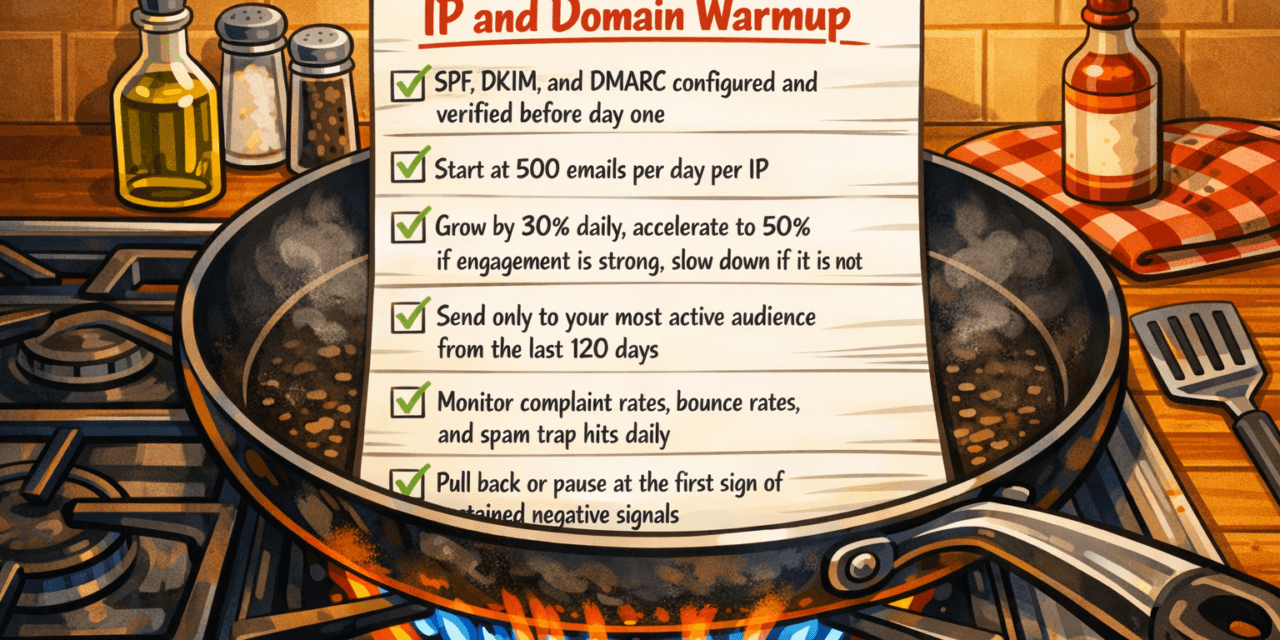
- SPF, DKIM, and DMARC configured and verified before day one
- Start at 500 emails per day per IP
- Grow by 30% daily, accelerate to 50% if engagement is strong, slow down if it is not
- Send only to your most active audience from the last 120 days
- Monitor complaint rates, bounce rates, and spam trap hits daily
- Pull back or pause at the first sign of sustained negative signals
- Do not introduce cold or unengaged contacts until reputation is established
This post was originally published on September 7, 2007 in response to a question posted to the Email Marketer’s Club. The core advice has held up well. The authentication section, volume ramp methodology, and domain reputation guidance have been updated in April 2026 to reflect current mailbox provider behaviour and industry best practices. This represents one practitioner’s tested approach. Your mileage may vary depending on your infrastructure, audience, and ESP.



These are excellent suggestions. I’d just like to underscore the vital nature of being able to monitor the reputation of your domains and IP addresses. Doing everything right, just as Matt has described, can put you on the road to rebuilding a tarnished reputation. But being able to monitor the effectiveness of those efforts and measure improvement over time requires the kinds of tools and relationships that a number of reputation monitoring services (my company’s included) can provide. Monitoring is the only way to know if you’re on the right track, and whether additional efforts are required.
Hi Matt,
What is the effect of not ramping up an IP – say if you do not have the volume needed? Can it still be done on a smaller scale?
Kelly